
Been a long while since my last update huh? Well, let me come right back at ya with this sweet ass Mind Spill consisting mostly of things I’ve thought of while I was chained up with papers and exams. Let’s begin!
Been a long while since my last update huh? Well, let me come right back at ya with this sweet ass Mind Spill consisting mostly of things I’ve thought of while I was chained up with papers and exams. Let’s begin!
My First VLog:
Was a lot harder to make than I thought, but if all goes well, I may do more. There’s one thing I must say though, you learn a lot of hard truths about yourself when you star VLogging…

The final installment of the Rocksteady Arkham trilogy has finally arrived, and its impact is exactly what you would expect from any hotly anticipated game these days. Most people have already decided that they love this game, and unfortunately, anyone that disagrees with this “well-founded” opinion is met with scorn and outrage. This happens every time with games that fall under the public’s favour and its kind of pathetic. Gamespot’s “divisive” 8/10 review of The Last of Us is an extreme example of this. According to many, this was the “final nail in the coffin” for Gamespot, as this paltry 8/10 review shows that they hate gaming and don’t understand anything about criticism… that is until Gamespot turns around and gives a game they know they’ll like a score they agree with, because in that case, Gamespot knows exactly what they’re doing and whoever else disagrees with them is crazy. We’ve seen this time and time again, and it has happened once again with Arkham Knight, for which Gamespot once again finds itself at the centre of its controversy. Giving the game a 7/10 score over criticisms that mostly centred around the use of the Batmobile (which is a legitimate problem), the review was met with a ton of backlash. Just outright hatred for a singular reviewer for having the audacity to not agree with them on one particular thing. Even more saddening is the fact that the type of people getting bent out of shape over reviews tend to fanatically cling to others who agree with them, even after naming those parties as trash over occasions where they weren’t in agreement. They go on long rants, comparing different review scores from games they didn’t like to the games they do to “prove” that they’re right about the reviewer’s inadequacy; as if to say that every review made for a website is from one person and that people can’t possibly enjoy things more than you did. You have to question their level of self-esteem and the value they hold in for their own thoughts and self-worth. I don’t understand why people need this type of validation when it comes to liking video games.
Continue reading “Batman: Arkham Knight and the Real Threat to Gaming Journalism”
 Kate McKinnon and Melissa McCarthy on the set of ‘Ghostbusters’. Proudly using this picture for my article instead of those GOD AWFUL photoshopped images of the stars heads on the original Ghostbuster bodies. Seriously those are disgusting, and they’re in like, every article about this. I mean come on.
Continue reading “There Is No Reason to Doubt the Ghostbusters Reboot”
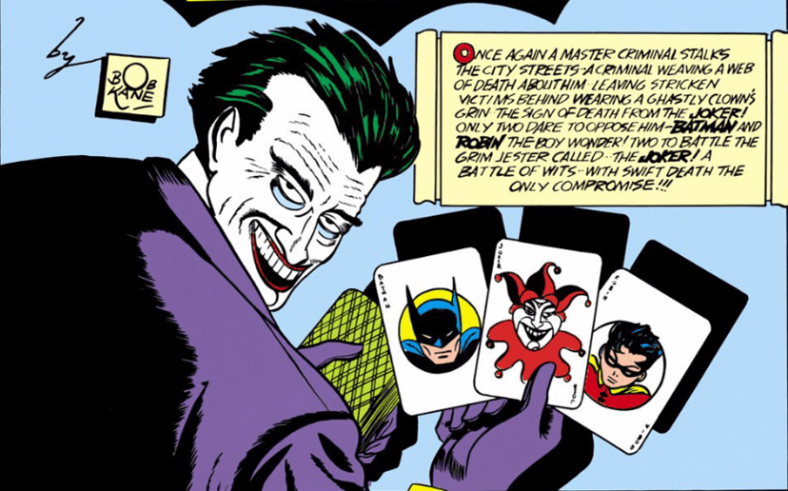
Oh wow, I never realized how fully realized the Joker was from his first appearance. This was a really interesting read, thanks!
Retro Review takes a look at influential issues of DC Comics and measures their artistic integrity against their cultural and symbolic importance to the DC Universe and comic books in general.

While last year marked the 75th anniversary of the Batman, this year mark’s the 75th anniversary of the debut of the Dark Knight’s self-titled solo series. Batman was one of the longest running continuous comic book series of all time, but more importantly, it was the series that introduced two of the most important and iconic characters in the Batman mythos.
One of these was Catwoman, the master thief and long-time paramour of the Caped Crusader. We will be covering her debut later on this year as part of her own 75th birthday celebration. But for today, we focus on the debut of Batman’s most iconic villain: his unrivaled archenemy, the Joker – otherwise known as the Clown Prince…
View original post 2,262 more words
I am thou, thou art I…from the sea of thy soul, I come…
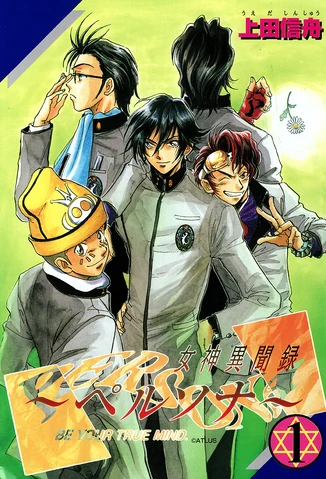
Every story has its beginning. Every successful gaming series has its origin. Shin Megami Tensei: Persona (originally a spinoff of the Megami Tensei series) was the game that started the Persona series. Though its gameplay was average at best, Persona 1 was praised for its use of Jungian psychology, compelling characters, and modern setting (aspects that are still prominent in modern Persona games). It sold relatively well in Japan and even managed get localized and released overseas (which was rare at the time it was released). It was eventually followed up by Persona 2, Persona 3 and Persona 4, and in truth, despite kickstarting Persona series, Persona 1 isn’t exactly well recognized by most Persona fans. In fact, if you’re reading this article, you’re probably significantly more familiar with Persona 3 and Persona 4, which is fine; Persona 1…
View original post 1,293 more words


 The Kenpire