What Is ‘Good’ Satire?

One of the most influential satirical pieces of all time…

What qualifies as “Good Satire”? Given the horrific recent events over in France, this is a question that has come up quite a bit. There is no debate that the actions of these terrorists are absolutely unconscionable, but there has been a large amount of discussion about what the best response to it actually is. The acclaimed cartoonist, Joe Sacco, and his response has had me thinking quite a bit about the nature of satire and why it exists. According the Oxford University Press, satire is the “employment, in speaking or writing, of sarcasm, irony, ridicule, etc. in exposing, denouncing, deriding, or ridiculing vice, folly, indecorum, abuses, or evils of any kind” (“satire” def. 2b). Satires often utilize sarcasm and irony to aid in getting their points across. Irony is a rhetorical device that depicts “a contradictory outcome of events as if in mockery of the promise and fitness of things” (“irony” def. 2). Under that criteria, how effective is the “satire” being employed today in response to this incident? What is really being accomplished by simply drawing a picture of Muhammed? To better articulate my thoughts, I’m going to look at 2 examples of satirical comics produced by Charlie Hebdo. One excellent, and one I would describe as vapid and pointless.

Continue reading “What Is ‘Good’ Satire?”

The “White Guilt Film” Complaint and Why it’s Offensive

Twelve Years a SlaveThe Butler, and even Django Unchained have been labeled with the “White Guilt Film” moniker. With Selma already receiving a great deal of positive buzz from critics, that phrase has seen a resurgence of use. And honestly? Labeling a film that covers things like slavery, discrimination, and other historical struggles for black people simply as “White Guilt Films” is an extraordinarily offensive thing to do. On top of that, it’s also incredibly arrogant and – I say this seriously – completely stupid. What’s worse is people are going further to state that these films are praised merely because critics are coerced into giving positive reviews out of some sense of guilt. Many negative criticisms on these films are often preceded by some variation of the absurd claim “Oh I’ll be called racist for not liking it”, which is a tellingly defensive thing to say and speaks volumes about the real racial issue that surrounds these movies. In this article, I’m going to unpack, analyze, and dismiss all of the “White Guilt Film” arguments, and hopefully by the end you will see how problematic they are if you don’t already.

Continue reading “The “White Guilt Film” Complaint and Why it’s Offensive”

Everyone has Butts: A Guide to Understanding Criticism on the Internet

Have you ever heard the phrase “Opinions are like butts”? It refers to the fact that everyone has one and it hints at the tendency we have to not be as accepting of ones that do not belong to us. After all, other butts tend to stink, and at the same time the stench of our own is a foreign element to others. The way it could be received on such an expansive platform like the internet is really anyone’s guess, and that in itself is source of the problem. Since so many different people have access to the web, a huge array of conflicting perspectives on things are going to clash. It is no exaggeration to say that there is no such thing as a subjective thought that someone on the internet does not disagree with. No matter how obvious and self-evident a perspective seems to you, there is definitely going to be someone out there who vehemently disagrees with it. Chances are on the web that if someone disagrees with something you said, they’ll let you know in the least graceful way possible. Often, this will lead to what we call an internet argument (you don’t want that, trust me). People on the internet have unfortunately gotten so used to being harassed over their opinions on things, that they have resorted to throwing out the pointless phrases “in my opinion” at the beginning of their statements and “but that’s just my take” at the end. We know it was in your opinion, the assumption that it wasn’t came from being on the internet too long. In a world where everyone is ridiculously self-conscience about their thoughts on things, we are now used to this fear of being ostracized for them. And fear is what it really comes down to on both sides.

Continue reading “Everyone has Butts: A Guide to Understanding Criticism on the Internet”

James Watson: Challenging What it Means to be Considered a Genius

James Watson is a Nobel Prize winning scientist who co-discovered the structure of DNA. On the flipside, he is also known for controversial opinions that include advocating the “right” for women to be able to abort their children for being gay, his obvious sexism, and most damning of all, his opinions about race in relation to intelligence. His behaviour has cost him the respect of his peers and his position in the scientific community, and in response he’s decided to sell his Nobel Prize, no doubt as a symbolic gesture of his disillusionment. My take on all this leads me to a number of conclusions about the nature of intelligence and people like Watson.

Continue reading “James Watson: Challenging What it Means to be Considered a Genius”

The Dirtbags of Popular Culture and Why They Exist

Dirtbags in fiction have been a fixture in popular fiction for a very long time now. They come in all sorts of varieties but with the common goal of earning the ire of an audience. They are that special kind of character that exists solely to be hated. The reason writers often resort to creating dirtbags is to give the audience a reason to side with the protagonist of their story. Maybe this hypothetical hero has entered a competition but you don’t quite care about whether or not they win, but throw in a dirtbag competitor and you can’t help but want to see that smug grin of their wiped off their face. In short, the dirtbag exists for the purpose of manipulating the audience, so here are a few different types that are used to do just that.

Continue reading “The Dirtbags of Popular Culture and Why They Exist”

Musings & Trollisms: A Guide to the Trolling Mindset

[Fibbing Intensifies]

Trolls are people who spread negativity on the internet through deception. This broad description of them is fitting because there are many different kinds of trolls. There are trolls who deceive people by deliberately saying something naive or stupid (EX: “How does this video have 10 million views, there are only 7 million people on the planet?”), and there are trolls that take on an unusually aggressive stance on something that really didn’t need one (EX: “Anyone who STILL believes in God is a confirmed idiot!”). Recently, a newer “roleplaying” type of troll that originates from the “Le Reddit Army”, who invade youtube comment sections and masquerade as stereotypical internet personalities like the “fedora-wearing-neckbeard” and the “angry feminist”. These trolls are meant to incite anger within people in two different ways. The ones gullible enough to actually buy their charade are offended by their patheticness, and the ones that can see through them are annoyed by the sheer volume of them that exist. Trolls often fight with meaningless nonsense, but they rely on their victim’s reaction for their “reward”, so in the end, trolls are only as effective as you allow them to be. On the other hand, there are those who enjoy harassing people, sending threats, saying explosively racist and offensive things, and telling others to kill themselves. These people are often identified as trolls, when in reality they are more akin to legitimate criminals and cyber bullies. Identifying someone that openly sends death threats as a “troll” downplays the seriousness of his or her actions. Actual trolling is like a balancing act, a line between legitimate and fraudulent, entertaining and disheartening, funny and sad; a line that must be carefully balanced upon. In the end, trolling is a performance, and the difference between a skilled troll and an artless basement-dweller is apparent. Before going any further, the question of why trolls troll must be addressed.

Continue reading “Musings & Trollisms: A Guide to the Trolling Mindset”

The Legend of Korra’s Weird and Wonderful Love Triangle

When people found out The Legend of Korra would focus on teenagers, they knew what it would result in. On some level I’m sure we all saw a lot of angst and heartache coming for these narcissistic little teenagers, and when it came, it brought out a mixed reaction (which is often the case with these things). The teens placed way too much stock on their romantic lives, they acted recklessly and selfishly, and none of them seemed to know what they really wanted… which is exactly like real teenagers. Trouble is, real teenagers have a habit of being infuriating. In the end, we received one of the most infamous romantic subplots of all time, and on an animated series no less. This one is going to be remembered for a long time because of the notoriously angsty behaviour these characters engage in, but also because of the unexpected and strangely fitting turns it takes. Before I discuss this particular love triangle though, its best to go over its players. We’ve got Korra (the show’s star), Mako (the original male lead), Asami (Korra’s chief romantic rival), and Bolin (a non-factor, but still worth mentioning).

The Original Love Triangle

Asami seeing the obvious

Continue reading “The Legend of Korra’s Weird and Wonderful Love Triangle”

The Thing About Love Triangles

Veronica Mars actors supporting their opposing factions by wearing the “wrong” T-Shirts.

Love triangles are essentially double-no, triple edged swords. They are tricky to begin, even harder to keep interesting, yet are incredibly easy engage the audience with. So many of these love triangles fall flat, but writers keep turning to them every chance they get. I have yet to see a single love triangle that didn’t do at least one thing wrong, but at the same time, I have yet to see a single repeated trope that gets as much as a response as these do. As terrible as they often are, people love love triangles. Everything about them just draws you in. They involve characters you care about, they incite dangerous shipping instincts in all of us, and they are so damn divisive. There is nothing in this world that unites us more than an enemy, and love triangles create them in spades. This is why when love triangles are introduced, people tend to classify their preferred choice for the fought over party with teams (Ex: Team Peeta vs Team Gale). Its that adversarial aspect that initially draws people in, but its also the ways people can relate to them in real life that strikes such a cord. Not everyone will be locked in a three-way love or death struggle, but whether you like it or not, someone’s going to end up on the wrong side of a choice between two suitors. However, even with our natural desire to be invested in romantic entanglements, they still tend to fall apart a lot for a few big reasons.

Continue reading “The Thing About Love Triangles”

The Hobbit: The Battle of the 3 Unexpected Desolations of Integrity in the Journey for Cash

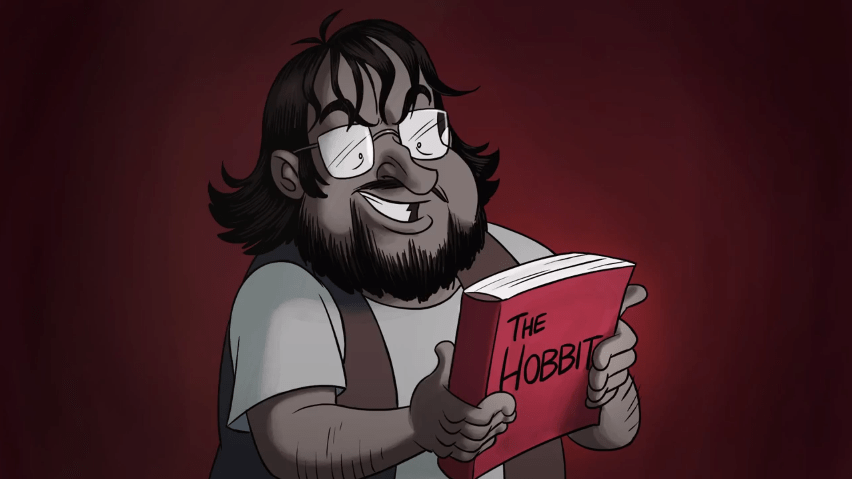
Credits to Harry Partridge (a youtube animator) for this excellent portrayal of Peter Jackson

Man do I hate The Hobbit movies. Yes, obviously I can’t stand what a blatant cash grab the franchise is, but there’s also the little personal reasons I have to hate it too. When I told people I was going to make a blog, this type of post was what they had in mind. Random vitriol pointed at something that probably doesn’t deserve it with nothing new or insightful to say about it. I think this post will fall into that category. So if you’re a big fan of the series (in which case we can’t be friends), stop reading now. Here are things I hate about The Hobbit, and the Lord of the Rings franchise as a whole.

Continue reading “The Hobbit: The Battle of the 3 Unexpected Desolations of Integrity in the Journey for Cash”

BoJack Horseman’s Christmas Special is a Triumph in Writing

“And a Goober in a Pear Tree!”

And with that jovial line-reading, the entire spirit of the holidays, sitcoms, and manipulative Christmas themed episodes are encapsulated. The Netflix original series BoJack Horseman stars a misanthropic, washed up television star that is going through depression. Also he’s a horse. Because he was the star of a popular 90’s sitcom titled Horsin’ Around (which ran for 9 seasons), he essentially has an endless flow of money. In the world of BoJack Horseman, where the titular star has nothing but time, he finds himself to be lonely. For this reason, he allows this dead beat named Todd to live with him rent free. Todd is mostly this chipper weirdo that shamelessly mooches off BoJack’s hospitality, and while he does have a habit of being grating at times (much to BoJack’s annoyance) he is perfectly utilized here. Todd is just one of the elements this episode handles so well, since on the whole it is a masterstroke of comedy.

Continue reading “BoJack Horseman’s Christmas Special is a Triumph in Writing”