The Legend of Korra and the Problem With its Villains

Writing villains is hard. This is often a problem because in the plots of many stories, the characterization of the villain is the most important component and often what makes them compelling. In large scale and themed stories, villains act as cautionary tales, tools writers use to help teach an important lesson in their stories. Within the world of the TV shows Avatar: The Last Airbender and its successor The Legend of Korra, villains largely fall into the role of “teachers”. They would take a certain ideology way too far and the audience and the characters in the story would come to understand the flaws in their thinking through their failure. Despite generally (and rightly) being regarded as a masterpiece though, The Last Airbender did not have many truly great villains. There was the ambitious Admiral Zhao of the first season who was held back by a level of patheticness that overshadowed the rest of his character, and there was the much talked about Fire Lord Ozai who was suitably cruel and unpleasant but also surprisingly generic (which is odd if you consider the fact that he was a character that was built up since the beginning of the series). The writers struck lightning (ha) when they created Azula, the chief antagonist of the second season, and the only compelling antagonist that remained after Zuko officially joined the side of the heroes (for real) in the third season. To put it bluntly, Azula was a stone cold bad ass, but at the same time she was the most developed and complex villain in the original series. The approach to developing Azula was definitely under a “less is more” philosophy, with little hints about her mental state being given here and there, and with the writers leaving a lot of things for the viewers to figure out. It was very intelligently done, and for those who were paying attention, it paid off big time in the finale with a powerful message about forming connections through love rather than fear. Unfortunately, most subsequent villains in the Avatar franchise started following Azula’s example in the “less is more” style of development, and eventually it was morphed into “less for the sake of less”. The precarious balance that was present for Azula’s development was lost. All the pieces are there, but the development never follows through. I’ve already discussed where Ozai went wrong (quick recap: he was surprisingly shallow), but what about the Korra villains?

Continue reading “The Legend of Korra and the Problem With its Villains”

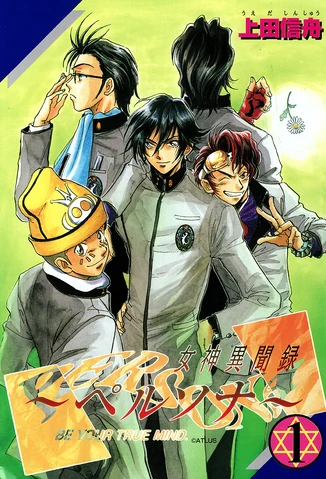
Manga review: Persona 1

truewildcard's avatartruewildcard

I am thou, thou art I…from the sea of thy soul, I come…

Every story has its beginning. Every successful gaming series has its origin. Shin Megami Tensei: Persona (originally a spinoff of the Megami Tensei series) was the game that started the Persona series. Though its gameplay was average at best, Persona 1 was praised for its use of Jungian psychology, compelling characters, and modern setting (aspects that are still prominent in modern Persona games). It sold relatively well in Japan and even managed get localized and released overseas (which was rare at the time it was released). It was eventually followed up by Persona 2, Persona 3 and Persona 4, and in truth, despite kickstarting Persona series, Persona 1 isn’t exactly well recognized by most Persona fans. In fact, if you’re reading this article, you’re probably significantly more familiar with Persona 3 and Persona 4, which is fine; Persona 1…

View original post 1,293 more words

The Newsroom on Rape: Misunderstood but Still Wrong

“Well, it’s complicated for a lot of reasons”

This is a phrase uttered by Don Keefer, a cable producer and one of the stars of Aaron Sorkin’s The Newsroom, regarding a certain rape incident at a University. After watching the controversial penultimate episode for the series “Oh Shenandoah”, I’m not sure he truly understands the complexity of the situation or rape in general. In fact, it seems as if he’s driven by the goal of simplifying it as much as possible to follow a moral guideline that does not really apply to the issue presented here. The issue being the fact that a woman was raped at her university by two men after being heavily intoxicated, and in retaliation (and after effectively being ignored by the police) she created a website for others like her to anonymously post about their sexual assault experiences and accuse their attackers. Don’s news corporation (ACN) would like for him to track Mary (the rape victim) down and invite her onto one of their shows for a joint interview between her and one of the men she is accusing. Don, due to his reservations about the nature of this hypothetical joint interview, tracks down Mary and does everything he can to convince her not to go through with it only to fail; but he ends up stopping it from happening anyways when he lies about being unable to find her to his furious superiors. This series of events, the portrayal of Don, and the execution of the story itself is problematic for a number of reasons, but I feel those reasons got lost in a barrage of righteous indignation that came about in response to the writing.

Continue reading “The Newsroom on Rape: Misunderstood but Still Wrong”

Things of Interest on Person of Interest

Watching Person of Interest has been an… interesting experience (pun obviously intentional, but also made with pride). This show, like The Good Wife is a hybrid of a procedural and serialized drama. To make a long story short, our heroes (the hyper intelligent Harold Finch and the highly skilled John Reese) receive tips on “people of interest” who are about to be involved in a violent crime, and then go to stop it. Along the way they have to balance fighting various criminal organizations and evading the law since what they are doing isn’t strictly legal. It’s fun, it’s action packed, and it comes with a whole slew of fun elements to point out. I’m only 2 seasons into the show, and after a shaky first season, it has picked up considerably. This is probably going to be closer to a traditional blog post than most things I’ve got on here so here goes. Here are random tidbits of interest on this show. There’s plenty of good things, dumb things, and hilarious things abound so get ready.

Continue reading “Things of Interest on Person of Interest”

Troy Baker’s Nightmare: A Voice Actor Shortstory

Disclaimer: If you don’t know anything about voice acting and Troy Baker in particular, you probably won’t enjoy this short story to the full extent that it can be enjoyed. All the context you need to have is that Troy Baker was a small time voice actor who hit it big and does less roles for obscure projects.

Troy Baker lies in his bed but he can’t sleep. Or he doesn’t want to. He’s not sure yet. All he knows is that he came home after recording lines for the protagonist of the latest Call of Duty game, and that means that sleeping will be hell. He did voices for the new Call of Duty game, so that means he is going to pay him a visit again. He does not question it, he just knows that it is a natural consequence of his actions of the day, just as it is a natural consequence for his body to seek rest. He hates the lack of control, he wishes he could either stop getting visits from him all together and just sleep, or that he could somehow will his body to not sleep at all. He chuckles to himself, remembering a character he once played with a similar dilemma, but he steels himself; determined not to succumb to his tiredness. But it’s no use, and without even realizing when or how, Troy Baker closes his eyes and goes to sleep.

Continue reading “Troy Baker’s Nightmare: A Voice Actor Shortstory”

Are Bioware Games Being Viewed as Dating Sims?

“Permission to dock?”

Bioware games have always been ambitious. They always try to hit every entertainment base imaginable, from gameplay to story, from mindless action to dramatic moments, from mystery to romance… Even as far back as in their breakout success, Star Wars: Knights of the Old Republic, romance has always been an element in their games. One small element, but an element nonetheless. Then a shift happened upon the arrival of their previous gen hits Mass Effect and Dragon Age: Origins. Bioware, being the Canadian and open-minded company they are, decided to really expand their romantic options in their games going forward. As a result, we’ve seen a rise of extremely divergent love interest options in videogames that we haven’t really seen in the past, and thanks the optional sex scenes, Bioware has created a veritable powder keg of controversy. The focus on sex and relationships in Bioware games has swelled to the point where it earns actual coverage from major news outlets. We are in the 21st century and people are still being scandalized by the idea of nudity, human-alien relationships, and homosexuality  in our videogames. Excuse me as a seriously contemplate whether or not I want to laugh or cry.

Continue reading “Are Bioware Games Being Viewed as Dating Sims?”

Tobias Fünke: Lord of Queer Humour

Gay jokes in fiction usually amount to this formula: one character says something that can also be interpreted as incredibly gay without realizing it and everyone looks shocked at him. The humour comes from the fact that this often happens in real life due to how far down the gutter our minds have gotten (everything can be construed as gay innuendo these days) and that these jokes in fiction capture those isolated moments of hilarity. The problem is they usually aren’t funny because of the fakeness of it all. It just comes off as manufactured and forced most of the time and the humour dies as a result. Every other sentence out of Alan Harper’s mouth on Two and a Half Men these days is a gay double entendre and it fails to crack even a grin from me. Yes, jokes like that tend to have no effect, except of course in the case of Arrested Development’s Tobias Fünke.

Continue reading “Tobias Fünke: Lord of Queer Humour”

Anatomy of a Joke: I Lie To Myself

30 Rock is a show where jokes fly at you so quickly and so consistently that you’ll find yourself still laughing at the last one that registered 3 jokes after it was told. Sometimes though, there are jokes that force you to sit and really think about them, jokes that will eviscerate you time and time again, jokes that you can re-watch endlessly and find something new to rave about… This here is one of those jokes. Allow me to break it down for you.

Continue reading “Anatomy of a Joke: I Lie To Myself”

Linda Belcher is the Best Sitcom Wife

Alriiiight, let’s talk about sitcom wives. The general role they’ve had all the way back since The Honeymooners was to be the voice of reason to balance out the craziness their husbands bring each week. The husband does something impulsive, the wife tells him how stupid it is to have done that. The husband wants to do something fun and irresponsible, the wife is always there to stop him. This is how it is, and it made sense for a while. Long ago, women were always seen as less intelligent and less capable than men, so in order to subvert that sitcom writers decided it’d be cool to to portray women as the smart and responsible ones married to men who are less intelligent and immature. Unfortunately this stuck long after people needed to be reminded that women are just as intelligent and capable as men, and what we have now is so much worse as a result. Leading women in comedy these days are worse than idiots, worse than flighty numbskulls, and worse than any diva brat the misogynist writers of old could possibly cook up. Women in comedy today are buzz kills. They’re here to tell their family to not do this or that, and to act like some lame authority figure that must be reported to or else they’ll nag. How many times do we see Homer desperately trying to appease Marge for disobeying her wishes to not do whatever dumb and irresponsible thing he did that week? How many times did we hear sitcom dads use the phrase “If my wife finds out, she’s going to kill me”? The answer to both those questions is “far too many times”. Recently however, there has been a shift. To balance out their nagginess, writers have taken to giving sitcom wives “crazy” quirks or weaknesses where they act out of character to show that they can be funny too. Unfortunately it just comes off as a hollow attempt to invigorate the most boring character on their show. Linda Belcher of Bob’s Burgers however is different. She can be “crazy”, and fun, and be a loving mom and still stay true to her character. It’s an impressive feat, but it’s also a trick only this show can pull off.

Continue reading “Linda Belcher is the Best Sitcom Wife”

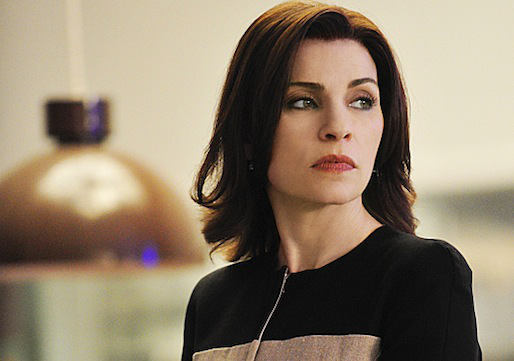
The Good Wife is the Most Impressive Show on TV

I love The Good Wife. It’s clever, bold, funny, and unbelievably resilient. I mention resilience because it’s what leads me to my conclusion that this show is the most impressive one on television. After just having its 6th season midseason-finale (where the show took another in a long line of enormous risks) while being well over 100 episodes old, I continue to be in awe of its ability to still be so damn good. Often being seen as a just another CBS procedural drama from those who don’t know any better, The Good Wife is head and shoulders above the rest of TV’s network dramas and is without a doubt on the level of prestige cable dramas such as Breaking Bad and Mad Men. The acting on all fronts is phenomenal, the scripts are fantastic, and mother of God is the satire on politics and the law on point. Perhaps cable dramas are more tightly written, with less plots being dropped or going undeveloped as they have on The Good Wife on occasion, but those shows don’t have to run for half as long as it does. The ability to churn out 22 quality episodes a year is remarkable on its own, but to be able to balance so many plots, character arcs, and themes just makes me want to scream out in empathy. “That’s just way too much work!” I want to say, but all that comes out is “thankyouthankyouthankyou!”, since this show ends up doing so much right.

Continue reading “The Good Wife is the Most Impressive Show on TV”